It’s almost a given fact that every crafty person participating in the SCA will have a blog of some form. With our modern tendency to create in isolation, we feel a desperate need to reach out and show what we have made, and what we do with the time we have. And so, there are countless testimonies to the creativity and craftsmanship within our little patch of the internet, where arts-and-sciencers put up their handiwork for specific events, periods or research spirals.
This is not one of those blogs.
For anyone who has come here outside this weird part of the world – welcome! SCA stands for Society for Creative Anachronism, and we are a social group who re-create and play with pre-1600 history across the globe. We run a wide variety of events ranging from feasts and tournaments to week-long camping expeditions in historic clothing, or at the very least an attempt at it. The bar to participation is on the ground, most people here downunder go about in Bunnings hats and hiking boots, but the ceiling is as high as you want it to be. We have all sorts, from those who wear a ratty worn-out tunic to every event and just hang out with friends, to fighters who put most of their efforts into their armour, to laurels, the knights of the arts and sciences, and even experimental archaeologists.
Through my time engaging with this society, I have formed many friendships, fallen in love, grown immeasurably and found the path I want to go down for my career: experimental archaeology and dress history. But the SCA is not the centre of my life – it’s a vehicle.
The SCA blog often features shortform posts about the making of garb (our attempts at pre-1600 clothing), or recounts of what happened at certain events, awards given, titles bestowed, and so forth. Many highly talented creators inhabit this space and make use of the skills and knowledge they have and the manufacturing methods they are familiar with to create outfits which expertly mimic historic clothing. But I am not interested in mimicry.
Machine sewing cotton fabrics into a dress that, as per the usual SCA rule, looks good enough if squinting through firelight, is a noble pursuit. I highly commend it. The ability to toss one’s garments into a washing machine after a week of muddy camping is very appealing.
And this is the beauty of the SCA, there is no right way to go about it – everyone has their own approach. With the ability to examine any time (that’s pre-1600) and any place, the limits fall away and we are able to expand our knowledge.
People hyper-specialise, and research niche historic cultures that are left behind in wider discussions of history, they gain valuable experience from re-creating their clothing, sometimes they eat the same food, and learn a variety of handcrafts in order to re-create, to the best of their ability, the material culture of their chosen period. But, broadly speaking, our reputation for accuracy isn’t stellar.
We’re a bunch of grown ups wearing silly costumes playing silly games with silly titles. We have a hitty-sticks contest every six months which determines our king (or, in theory queen, but this has yet to happen), many of our fighters wear a motley assemblage of thick plastic, aluminium plates and leather that is entirely un-historical, and we fight using rattan instead of metal blades.
But on the flip side, we don’t push for ‘accuracy’ when it comes to mobility aids, and our low, low bar to participation means that complete novices can easily join and enjoy themselves. It’s also important to note that this society began in the USA, and I am part of the Australian chapter – there are enormous differences between us, our local cultures and how we approach things.
There are many things I love about the SCA, but I find it healthiest to view it as a community and a conduit. I possess a deep passion for re-creating the clothing and materiality of historic peoples, those of pre-1600 north-west Europe; the British Isles in particular, but have been cursed (or blessed?) with growing up here in the land downunder. It’s bloody hot half the year, and we just don’t have the kinds of resources that Europeans or even Americans have. We just don’t have living history sites like Colonial Williamsburg or Lejre Land of Legends.
This is where the SCA comes in – it is a conduit through which I pursue living history.
And so, here we come to the main point of this post – this is not an SCA blog.
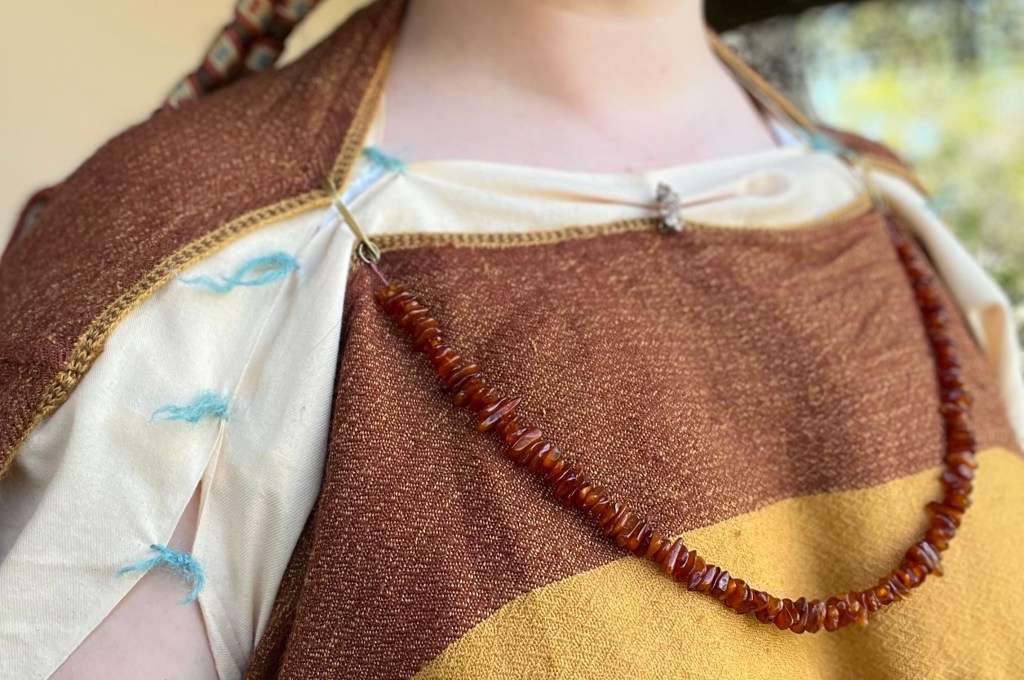
My approach is not to make ‘garb’, nor ‘costumes’, but clothing. Wearable clothing that resembles, and is made using appropriate techniques to, actual garments worn by people in a specific time and place. To be absolutely clear, I do not place any judgement on people who don’t do this, nor do I care whether you hand or machine sew your authentic wools or Spotlight cottons – everyone’s approach is their own. My approach is just different, and this is largely due to my background.
I’m an experimental archaeologist. I have a bachelor’s degree majoring in archaeology and English, and am a higher degree by research candidate commencing in a few months – I love to research with a fiery passion. Whilst working my first post-uni job, I got a little bored and so spent every spare minute assembling several hundred pages of notes on 16th century Irish clothing. This ended up forming the background research for my masters.
I’m a spinner, a weaver, a natural dyer, and a sewist with aspirations to take on felting, språng, nålbinding, leatherwork and more – just to get closer to historic people. I believe that clothing is one of the most intimate ways we can know a culture, by the materials they put on their backs. So much meaning and expression is contained within clothing, and I am ever seeking to translate the lost languages of sartorial politics across space and time.
Making historic clothing is not my hobby, it’s my career. I take it extremely seriously.
I actively participate in the SCA. I greatly value all that it does and makes space for its members to do. But I don’t make garb for events, I make clothes, which I then wear at events, as well as in day to day life, because for me, they are clothes, and not costumes.
As a child, I would sit in front of the television with a sketchbook and pencil and draw the outfits I saw characters wearing, paying particularly close attention to period pieces. As a teenager, I began to dress in 1940s and 1950s clothing and toyed with pursuing costume design. But when my HSC came upon me, I buried these intentions to be more ‘serious’ and pursue science. After joining the SCA and changing my pathway to pursue archaeology, I rediscovered my passion and soon, it took off. Five years ago I didn’t know anything about the medieval period beyond snippets from Horrible Histories, now I’m pursuing postgraduate studies in that area.
The SCA got me started on my journey of historic dress, but it is not the reason I do what I do, it’s the vehicle I use to achieve my goals.
And so, this is not an SCA blog. It’s a blog for the examination and re-creation of historic material culture as part of my pursuit of experimental archaeology. A pursuit that has taken me on a thrilling journey in a direction I never would have expected, a journey I am grateful for you joining me on, dear reader.
Until next time
Kate
 Picts or it Didn't Happen
Leave a comment