Part Two: Peasant Mens’ Dress
Welcome or welcome back, dear reader,
Today I am stepping outside of my usual comfort zone of women’s dress to examine the clothing of men in the lower strata of 16th-century society. As with my prior edition on womens’ dress in the FitzWilliam Hours, not every character displayed here is necessarily a peasant, but I’m using the term as a sort of catch all for people engaged in agricultural labour.
The FitzWilliam Hours is currently housed in the FitzWilliam Museum in Cambridge, England, under the registration MS 1058-1975, and was originally produced as the result of collaboration between multiple masters in Bruges around 1510-1520. Books of Hours typically feature calendars of holy days, and the more elaborate and expensive Hours are often richly decorated with scenes of farm workers whose tasks vary according to the season. As many of the labour tasks shown are heavily gendered as male, there is often an abundance of male figures in these books, so you will note that we have a lot more to look at than we did last week.
This series on dress in Books of Hours is the result of my trawling through hundreds of freely accessible digitised manuscripts available online to look for examples of common peoples’ dress.
Once again, a word of caution before leaping in – as a manuscript produced in Bruges and featuring styles of dress associated with the Lowlands, apply caution when using this manuscript as a resource for dress outside the Lowlands region.
Please note that there is variation in image quality due to variation in quality of digitised folios as found in different parts of the FitzWilliam Museum’s website.
As this is my first post on mens clothing, we’ll go through some basics.
Like womens’ dress of the same period, menswear is heavily reliant on the use of layers. A plant fibre shirt is worn directly next to the skin, and differs from the woman’s shift in that it doesn’t have side gores, but is instead split to the hip or waist, so that the front and back pieces can be tucked around the nether region prior to putting on the tight fitting hose. There are some examples in Books of Hours of underpant-like garments, but none in this edition, and they could always be cleverly tied pieces of cloth rather than a structured garment. Plant fibres used generally extended to flax, hemp and nettle, and the shirt both protected the outer garments from the oils and sweat of the wearer, and the wearer from potentially scratchy outer garments.
Petticoats are recorded in English wills and inventories for men as well as women, and it’s likely that the function is much the same – an extra layer worn for warmth – but the more important garment that was typically the next layer, is actually two garments. One for the torso, another for the legs; the doublet and hose. Often pointed or laced together, the doublet helps to hold the hose up, as well as provide structure upon which to place further layers, whilst the hose covers the legs, often in their entirety. Many of the pairs of hose seen in the FitzWilliam Hours are similar to present-day tights in that they cover the foot, leg, buttocks and part of the hips. Unlike tights, however, they would be made of wool fabric cleverly cut on the bias to maximise natural stretch, and feature a flap at the front in the form of a codpiece which covers the ‘nads’ and could be padded to protect them or to, erm, demonstrate one’s virility.
Truly, codpieces are one item of 16th century dress that us modern folk can’t really get past. I’ve heard a persuasive theory from a friend as to why they went out of fashion: a whole generation of children grew up with them at eye level. But moving on…
Over the doublet you could wear a jacket. Jerkins became more popular towards the second half of the sixteenth century, so we’re going to stick with jackets for now. The jacket was the medieval blazer, if you will, a chance to show off with interesting cuts and expensive fabrics, some appear to be fully sleeved, others sleeveless entirely.
Over the jacket you could wear a coat or gown. Typically reserved for the poorer lot, and a very common item in livery, the coat is put on primarily for warmth. I will be using the term ‘coat’ in reference to garments that clearly split down the front the full way, but referring to tunic-like garments closed the full way around in the skirt and/or bodice as ‘gowns’. Gowns, like coats, were worn for warmth, and long gowns aren’t unheard of.
Most mens’ dress in this era features skirted garments falling to the knees, but ankle-length skirted garments are also worn. There is no gendering of the wearing of skirts in this period, they just tend to be shorter for men. A man wasn’t considered dressed if he went out just in a doublet and hose, and many of the examples of men wearing only these layers (or less) are engaged in intensive physical labour, where the removal of garments was necessary to avoid overheating.
Here’s a table summary of the different garment types we’ve just been through, as well as some suggestions for materials.
| Layer 1 | Shirt | Linen/hemp/nettle, split at sides to tuck around nether region |
| Layer 1.5 (optional) | Petticoat | Wool, could be silk for elites |
| Layer 2A | Doublet | Wool, could be silk for elites |
| Layer 2B | Hose | Wool, cut on bias for stretch |
| Layer 3 | Jacket | Wool, could be silk for elites |
| Layer 4 | Gown/Coat | Wool, could be silk for elites |
Shirt
 |  |  |
| Folio 7r, July: Farmer, harvesting wearing shirt, shoes and hatVia Fitzwilliam Museum online collection | Folio 8v, August: Farmer gathering grain, wearing shirt, petticoat or doublet and hose with cap and shoes. Note the shirt’s ungathered, rectangular sleevesVia Fitzwilliam Museum online collection | Folio 8r, August: Farmer separating grain, wearing shirt with split sides and sleeves rolled up, hose rolled down and petticoat or doublet, shoes and hatVia Fitzwilliam Museum online collection |
These three images all give us a good idea of what the working man’s shirt could look like. In the left image, a farmworker has discarded all other garments for harvesting in the midsummer heat, note the splits at either side and the apparent belting to create a slightly bloused effect. The central image shows the straight, ungathered nature of the sleeves which facilitates rolling them up for intensive tasks. The figure on the right has rolled his sleeves up and his hose down to let the shirt hang loose underneath a petticoat or skirted doublet
Hose
 |  |  |
| Folio 8r, August: Farmer separating grain, wearing hose over shirt and cap. Note the footed nature of the hose and how the shirt is tucked into them.Via Fitzwilliam Museum online collection | Folio 2v, February: Labourer cutting wood or pruning trees, wearing hose pointed to doublet, cap and shoes. Note the separate flap of the codpiece.Via Fitzwilliam Museum online collection | Folio 2v, February: Labourer tying a bundle of sticks, wearing hose pointed to doublet, shoes and possibly cap. A good representation of how tight hose could be!Via Fitzwilliam Museum online collection |
In these three pictures (above), we get a good idea of just how tight the hose could be – this tightness was achievable in part due to their construction as two separate legs with a central flap (the codpiece) to cover the genitals. The figure on the right in particular emphasises how bias cutting can achieve a figure hugging look! Note the central figure, whose hose are pointed to a doublet. By pointing the hose to a torso-covering garment, the need for a tight belt is eliminated and the weight more comfortably dispersed across the whole torso, in particular the shoulders, rather than digging in to the upper hip or waist, which could potentially become uncomfortable, especially when considering daily fluctuations in waist size due to eating!
Discarding hose in hot weather
 |  |  |
| Folio 6r, June: farmer cutting grass for haymaking, wearing shirt split at sides, petticoat, cloth tied around the shins, hat and shoes.Via ILLUMINATED: Manuscripts in the making | Folio 6r, June: farmer wearing shirt and petticoat or sleeveless jacket, with shoes.Petticoat – longVia ILLUMINATED: Manuscripts in the making | Folio 6v, June: farmer haymaking, wearing shirt, petticoat, cloth tied about shins, shoes and hat.Via Fitzwilliam Museum online collection |
In these three examples (above), we can see farm workers engaged in haymaking who have discarded their hose in the summer heat, and opted for loose and flowing garments to allow for a breeze. Our figures on the left and right have wrapped cloth about their shins to protect them, in a manner that reminds me of the sock guards my father would wear when gardening. All three men are wearing either petticoats or short-sleeved jackets.
Doublets
 |  |  |
| Foloi 3r, March: labourer wearing doublet pointed to hose, cap and shoes. Again, we see the distinct flap of the codpiece.Via Fitzwilliam Museum online collection | Folio 3r, March: labourer wearing hose and doublet with petticoat or sleeveless jacket worn over. Once more, note the tightness of the hose.Via Fitzwilliam Museum online collection | Folio 10v, October: farmer broadcasting seeds, wearing hose and doublet with hat, shoes and distinct apron.Via Fitzwilliam Museum online collection |
These three figures (above) are seen to be wearing doublets with hose attached. On the left, we can see the ties where the garments are pointed together, as well as the centre-front opening of the doublet. The central figure is wearing a sleeveless jacket or petticoat over his doublet, and again, demonstrates the tightness of the hose! The figure on the right is wearing a simple apron commonly seen in sowing scenes which holds the seeds for broadcasting, whilst also protecting the clothes.
Layering with doublets
 |  |  |
| Folio 12r, December: labourer roasting a Christmas hog, wearing doublet and hose with petticoat or sleeveless jacket over, cap and shoes with apron.Via ILLUMINATED: Manuscripts in the making | Folio 3r, March: labourer digging, wearing doublet and hose with petticoat or sleeveless jacket, shoes and hat.Via Fitzwilliam Museum online collection | Folio 11v, November: farmer herding hogs, wearing doublet and hose with long sleeveless gown hitched up, and hat.Via ILLUMINATED: Manuscripts in the making |
In the above images we can see the layering of sleeveless layers over sleeved (presumably petticoats, jackets and gowns over doublets) for extra warmth. Our figure on the left (above) spots a short skirted garment, the front of which is obscured by an apron, whilst our central figure’s garment (likely a petticoat) is only fastened at the waist. The figure on the right appears to be wearing a loose, sleeveless gown hitched up for practicality.
Jackets
 |  |  |
| Folio 3r, March: labourer digging in hose and open jacket, with coif-like cap fastened under chin and shoes.Via Fitzwilliam Museum online collection | Folio 3v, March: labourer wearing hose, doublet and jacket, with hat and shoes. Note the ruching on the tops of the shoes, which suggests they are cut as a single piece of leather and then sewn up over the foot.Via ILLUMINATED: Manuscripts in the making | Folio 3v, March: labourer wearing hose, doublet and jacket, or doublet and two jackets, with cap and shoes. Note the stylised slash at the sides of the outer garments.Via ILLUMINATED: Manuscripts in the making |
One thing you might notice when looking at contemporary images of men in the 16th century, as well as earlier in the medieval period, is that their waistslines and belts sit, well, on the waist. Whilst this might feel strange to our modern man, it helps tremendously with the proportions, and particularly serves to elongate the legs, making the wearer appear taller. Some men might not know where their waist is, and fair enough, you’re not usually expected to make use of it in modern fashion – try bending to your side, and the point where you bend, right under the hips – that’s the waist. On the left (above) we have a figure wearing a partly open jacket over his hose, whilst in the centre we get an excellent view of the seaming at the back of the jacket, and the central and right figures both have slashes or slits in the sides of their overgarments, presumably for ease of movement.
Gowns and coats
 |  |  |
| Folio 11v, November: farmer selling hogs, neckline of doublet or jacket visible above loose gown reaching the knees, hose, shoes and capVia ILLUMINATED: Manuscripts in the making | Folio 2v, February: labourer cutting wood or pruning trees, wearing a coat or gown over hose – note the central back seam and pleats. He also sports hose, shoes and a woolen hat or cap with an upturned brimVia Fitzwilliam Museum online collection | Folio 9v, September: labourer picking grapes wearing hose and a gown belted at the waist (not at the hip, lads!), shoes and a capVia ILLUMINATED: Manuscripts in the making |
Our figures above have put on their coats and/or gowns in the cold weather, which appear remarkably similar to the basic t-tunics of the early medieval period. As there are no clear openings, presumably it would be pulled over the head, similar to a pullover or jumper, and the skirts extending over the thighs would add some extra warmth.
Long gowns
 |  |  |
| Folio 9v, September:Hose, jacket, long gown hitched up for ease of movementVia ILLUMINATED: Manuscripts in the making | Folio 4r, April: farmer wearing hose and a long gown or coat, with shoes and black cap.Via ILLUMINATED: Manuscripts in the making | Folio 11r, November:hose, long gown hitched up for ease of movement, hatVia Fitzwilliam Museum online collection |
Here (above) we can see some longer outergarments, including the examples on the left and right which are long enough as to merit being hitched up and tucked through the belt for ease of movement. I really don’t think enough men appreciate how comfortable skirted garments can be, it’s much like wearing a blanket around one’s legs.
Hoods
 |  |  |
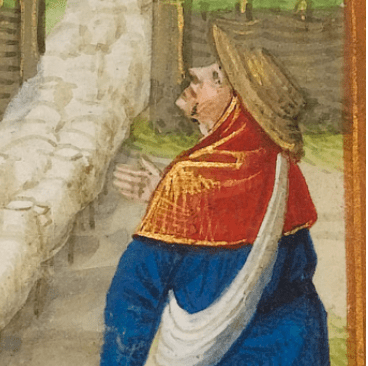
| Folio 4r, April: farmer wearing hose, shoes, gown hitched up at the side, hood and hat. Note the sling-like bag over his shoulder.Via ILLUMINATED: Manuscripts in the making | Folio 2v, February:Hose, split-sided coat or gown, hood and hatVia Fitzwilliam Museum online collection | Folio 11r, NovemberHose, split-sided coat or gown, hoodVia Fitzwilliam Museum online collection |
These three images show the wearing of a garment more commonly associated with the medieval period and famously out of fashion, at least for elites: the hood. Unsurprisingly, a highly practical garment of this nature continues to be worn by the working members of society, both to keep the neck, shoulders and head warm, but also to protect from the elements; wind, rain, snow, and sun. On the left, we see a long gown (reaching the ankles, no less), hitched up over one leg; whilst the centre and right figures show split-sides coats or gowns worn under the hood.
The images used in this post are just a small selection of those available in the richly decorated FitzWilliam Hours, and don’t quite cover the breadth of male dress in this book. I highly encourage you to look at the whole book as it is beautiful, and I have only been taking from the calendar section – the religious scenes are particularly stunning.
The contents of the book can all be found via the FitzWilliam Museum’s online collection, with higher quality digitisations of some folios via ILLUMINATED: Manuscripts in the making, located here https://fitzmuseum.cam.ac.uk/illuminated/ (link accurate as of 26 February, 2025).
Digitisation of resources really is a wonderful thing and I commend the FitzMuseum for allowing the free use of content and images on this website for research and educational purposes. The images taken from the online collection are covered by a Creative Commons Licence for non commercial use.
Digitised edition: https://fitzmuseum.cam.ac.uk/illuminated/manuscript/discover/book-of-hours (link accurate as of 19 February, 2025)
Online collection edition: https://data.fitzmuseum.cam.ac.uk/images/id/170636 (link accurate as of 19 February, 2025)
Thank you heartily for reading, and keep an eye out for further editions. Next week, we will be looking at servants’ dress. Consider subscribing so you won’t miss it.
Until next time
Kate
 Picts or it Didn't Happen
Leave a comment