Part One: Peasant Womens’ Dress
The subtitle of this post is something of a misnomer – the term ‘peasant’ is often vague and doesn’t help in trying to split up the lower strata of 16th century society – but it remains a useful catchall for the more ‘lowly’ people, especially in an informal publishing setting like, say, a blog.
Today we’re looking at peasant women’s dress in the FitzWilliam Book of Hours. Currently housed in the Fitzwilliam Museum of Cambridge, England, this manuscript (MS 1058-1975) was originally produced in Flanders, possibly in Bruges around 1510-1520 and is the result of collaboration between multiple masters.
Whilst scholarship on Books of Hours is plentiful, it has largely been centred on art history, that is, the techniques and methods with which these manuscripts are produced, or their religious links, as opposed to analysis of the material they directly represent. Therefore, it is my opinion that they constitute a largely untapped resource for contemporary depictions of dress.
On that note, it is important to state that the colours shown in these manuscripts aren’t necessarily accurate to the actual colours of the garments depicted. However, the presence of bright and clear colours remains noteworthy and supports the understanding of the availability of colour among working class people.
Before we get into it, a note of caution. Lowlands sources have frequently been used directly and without contextual consideration as ‘evidence’ for English dress styles, and I would strongly caution the 16th century enthusiast against doing so. Yes, there is remarkable consistency in the basic elements and styles of clothing across Europe in this period, but the way they are combined and styled (i.e. ‘dress’ not simply ‘clothing’) varies considerably according to nationality, region, religious beliefs, social stratum etc. etc.
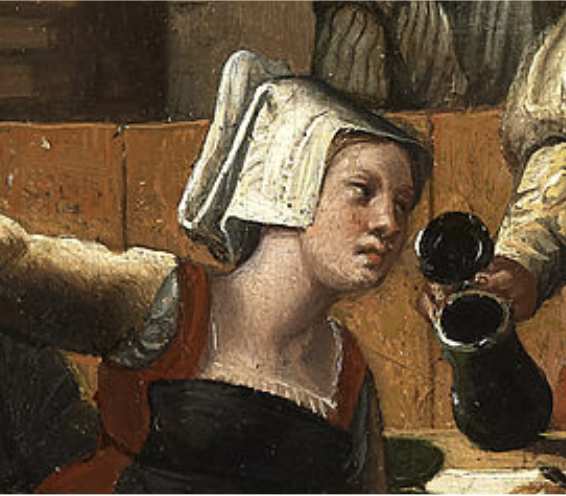
Having been produced in Flanders, I believe it is fair to assume that the clothing on display in this Book of Hours most closely resembles styles of the Lowlands, and certain details corroborate this, for example, the draped linen headdress in a similar shape to a ‘French hood’ sported by the figure of a woman (see below)
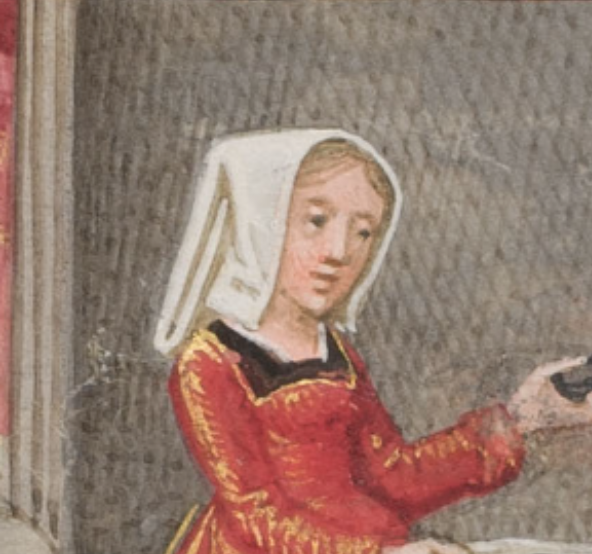
- Left: Folio 1v – January; Via ILLUMINATED: Manuscripts in the making.
- Right: Detail – An Inn with Acrobrats and a Bagpipe Player https://commons.wikimedia.org/wiki/File:Brunswick_Monogrammist_-_An_Inn_with_Acrobats_and_a_Bagpipe_Player.jpg (link accurate as of 19 Februrary 2025)
As this is an early post, we’re going to go through some definitions and basics of 16th-century clothing.
When examining historic dress, by far one of the most important things to consider is the layering. Outfits, similar to today, are comprised of several layers of different garments to create different looks, and the ordering of these layers is quite consistent, similar to how (except for some adventurous souls) bras go under shirts and so forth. With historic clothing, the specific order of the layers is vital to the functionality of the ensemble.
For example, the linen (or hemp or nettle) shift is always worn next to the skin to separate the outer layers from the skin and provide an easily changeable (and washable!) layer to aid in the protection of outer garments from oils and sweat as well as the skin from potentially scratchy materials.
The next layer is a kirtle, a structured and often laced, dress-like item which helps to mould the body into the acceptable silhouette as well as provide vital support for the breasts (no bras in the 16th century!). A potential intermediary between the kirtle and shift is a petticoat, which appears to be visually indistinguishable from a kirtle, but functionally very different. Consider a singlet versus a tank top – one is worn under other garments for warmth, whilst the other is a visible garment in its own right – and yet, they are fundamentally the same garment. So it is with the petticoat; it is another layer added for warmth. Some petticoats and kirtles have sleeves, some do not, and they have a range of neckline and fastening options. For my purposes now, however, we’re just noting what can be observed in one source.
The final layer is the gown. Consider this a coat or blazer – worn not only for extra warmth, but also for presentation and to convey a sense of formality or put-togetherness. Gowns could be open all the way down, partly open, or fully closed with a range of closures from pins to hooks and eyes to lacing.
So keep in mind our order of layers for the examples we’re looking at;
| Layer 1 | Shift | Linen/hemp/nettle |
| Layer 1.5 (optional) | Petticoat | Wool, with upperbodies wool or linen; could be silk for elites |
| Layer 2 | Kirtle | Wool, with upperbodies wool or linen; could be silk for elites |
| Layer 3 | Gown | Wool, could be silk for elites |
Dress for warm weather
 |  |  |
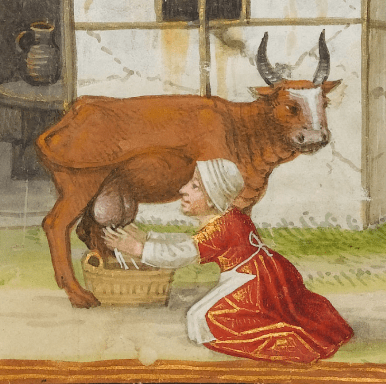
| Folio 4v, April: female farmer milking cow, wearing shift, short sleeved kirtle or petticoat, apron and cap kerchiefVia ILLUMINATED: Manuscripts in the making | Folio 6v, June: female farmer, haymaking, wearing shift, sleeveless kirtle or petticoat, boots or black hose and shoes, cap kerchief and straw hatVia Fitzwilliam Museum online collection | Folio 7r, July: female farmer harvesting with sickle, wearing shift, short sleeved kirtle or petticoat, cap kerchief and black boots or shoesVia Fitzwilliam Museum online collection |
These three examples are very similar, all showing red kirtles or petticoats worn without other garments on top of them due to heat or practical reasons. Note the straight sleeves of the shifts, which aren’t gathered into cuffs, making them easier to roll up for practical tasks. As for the kirtle/petticoat, we can see both short sleeved and sleeveless styles, on which separate wool sleeves could be pinned to cover the arms. The first two images show a concentration of pleats towards the back, with the second figure’s bodice back dipping into a v, revealing the comparatively straight edge of the shift beneath. Also of note is the shorter length of the second figure’s kirtle, which appears to reach the lower calves, whereas the other examples seem to reach either the ankles or the ground.
All three figures wear cap kerchiefs, which are held close to the head with a strap wrapped around where the braided hair beneath would sit. In the second example, a straw hat has been added (definitely recommended for haymaking in the hot summer heat). The first figure also wears a rectangular apron with the edges hanging free of the waistband, which allows a smaller piece of fabric to cover more of the skirts.
Dress for cooler weather
 |  |  |
| Folio 9r, September: female farmer wearing petticoat and kirtle over shift, cap kerchief and black shoes.Via Fitzwilliam Museum online collection | Folio 9v September: female farmer wearing petticoat and kirtle over shift, cap kerchief and black shoes.Via ILLUMINATED: Manuscripts in the making | Folio 12r December: female farmer wearing petticoat and kirtle over shift (neckline visible), separate sleeves over kirtle, cap kerchief and black shoes.Via ILLUMINATED: Manuscripts in the making |
Thanks to the classic hitching up of an overskirt, here we can see the wearing of multiple layers – either a short sleeved or sleeveless gown or a kirtle worn over a petticoat. Given that gowns were broadly intended to cover the arms, however, I have referred to these over garments in the captions as kirtles. Working from the inside out, again note the straight and ungathered shift sleeves, then the fullness of the skirt. This style of overskirt tuck has been observed on many images from the 15th century, with much debate as to how it is performed – it is possible that a belt is used to hold things up in place, but perhaps some experimental archaeology may be of use…
In the third image we can see a pair of sleeves being worn over the shift sleeves, almost certainly pinned in place onto the kirtle beneath. Again, we see the cap kerchief with band – observe in the second image a central line, which could be a seam or a crease from pressing. Here the shoes only just peek out underneath the hems.
That covers the peasant womens’ dress styles present in this Book of Hours – if you want to look at the whole thing, I highly encourage doing so, and check out the FitzMuseum, linked below.
This is by far one of the most charming little tomes I’ve looked at, and there’s something enchanting about the small figures in Lowlands miniatures.
The contents of the book can all be found via the FitzWilliam Museum’s online collection, with higher quality digitisations of some folios via ILLUMINATED: Manuscripts in the making, located here https://fitzmuseum.cam.ac.uk/illuminated/ (link accurate as of 19 February, 2025). Digitisation of resources really is a wonderful thing and I commend the FitzMuseum for allowing the free use of content and images on this website for research and educational purposes. The images taken from the online collection are covered by a Creative Commons Licence for non commercial use.
Digitised edition: https://fitzmuseum.cam.ac.uk/illuminated/manuscript/discover/book-of-hours (link accurate as of 19 February, 2025)
Online collection edition: https://data.fitzmuseum.cam.ac.uk/images/id/170636 (link accurate as of 19 February, 2025)
Thank you for reading and keep an eye out for my next edition, which will be looking at peasant meanswear in the same book of hours – consider subscribing so you won’t miss it
Until next time
Kate
 Picts or it Didn't Happen

Leave a comment